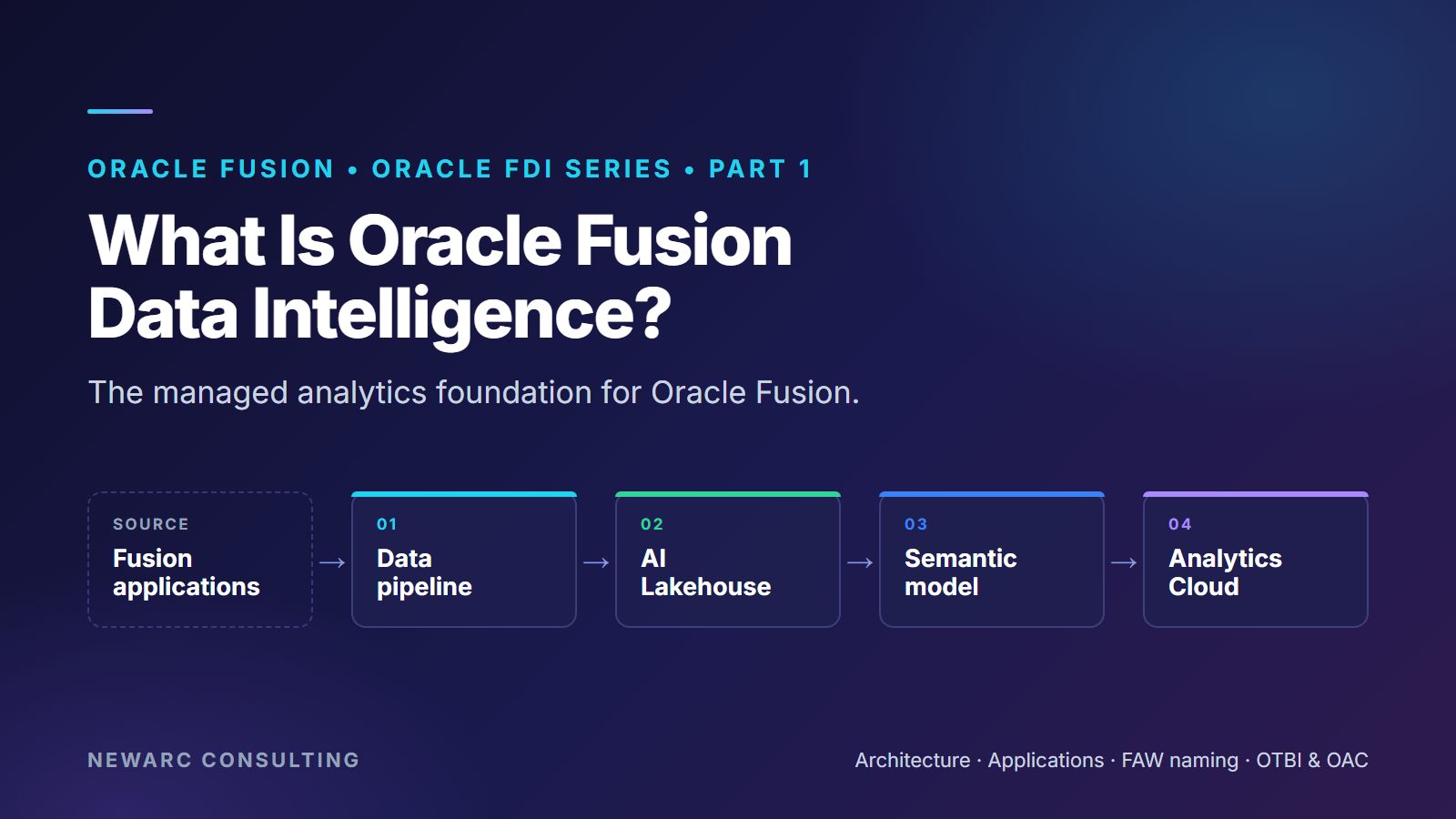
Oracle Fusion Data Intelligence (FDI) is Oracle’s managed suite of prebuilt analytics applications for Oracle Fusion Cloud Applications. It combines a data pipeline, an analytics warehouse, a governed semantic model, and Oracle Analytics Cloud (OAC) to turn Fusion data into business insight.
For finance leaders, controllers, and Fusion ERP teams, FDI gives you a shared foundation for analyzing performance over time. This article explains what it includes, how its applications fit together, and why it complements operational reporting rather than replacing it. If you know the older name Fusion Analytics Warehouse (FAW), you are looking at the same service under its current name.
What to remember
- FDI is a managed analytics service. It includes the data foundation and packaged business content.
- Fusion ERP Analytics is one FDI application. HCM, SCM, and CX Analytics are its siblings.
- Refresh timing matters. FDI analyzes replicated data; check operational questions in Fusion or OTBI.
What does Oracle FDI include?
FDI packages the work between a Fusion transaction and an analytical view. Oracle manages the prebuilt service; your team configures its scope, user access, and supported extensions. The underlying analytics components are Oracle Autonomous AI Lakehouse and Oracle Analytics Cloud. Oracle’s service overview describes this managed stack.
From Fusion data to business insight
- Source systemFusion Cloud ApplicationsTransactions and business processes
- FDI · 1Managed data pipelineScheduled extract and load
- FDI · 2Autonomous AI LakehouseCurated data for analytics
- FDI · 3Governed semantic modelShared business definitions
- FDI · 4Oracle Analytics CloudWorkbooks and visualizations
Here is what each layer does in business terms:
| Layer | What it does |
|---|---|
| Fusion Cloud Applications | Hold transactions and business processes in ERP, HCM, SCM, CX, and related applications. |
| Data pipeline | Copies data from enabled functional areas into the analytics warehouse on configured schedules. |
| Autonomous AI Lakehouse | Stores the data used for analytical queries. |
| Semantic model | Presents business measures, dimensions, relationships, and subject areas consistently. |
| Oracle Analytics Cloud | Provides workbooks, visualizations, dashboards, and self-service exploration. |
| Prebuilt analytics content | Adds packaged metrics and analyses for the subscribed business applications. |
Oracle handles deployment, performance monitoring, upgrades, and maintenance of the prebuilt content. Your business still needs to decide which questions matter and check that the resulting measures match its reporting requirements.
Which applications belong to FDI?
The FDI family covers four business areas. The applications share the same style of managed data foundation, with content shaped for different users. Oracle’s FDI product page maps the suite.
One FDI family. Four business areas.
Fusion ERP Analytics
Finance, procurement, projects
What drives financial performance?
Fusion HCM Analytics
Workforce and people
How is our workforce changing?
Fusion SCM Analytics
Supply chain operations
Where are inventory risks emerging?
Fusion CX Analytics
Sales and customer experience
How is the sales pipeline evolving?
For a controller or finance analyst, Fusion ERP Analytics is usually the place to start: its scope covers finance, procurement, and projects. Check which applications and functional areas are in your subscription before assuming a cross-functional question is available out of the box.
Oracle’s current product positioning also includes embedded AI, natural-language exploration, and predictive insights. Confirm what is available for your subscribed application and deployed release when you scope an implementation.
Is FDI the same as FAW?
FDI is the current name for the service previously called Fusion Analytics Warehouse. Oracle’s June 2024 rebrand notice said the name change had no impact on current services and required no customer action. That covers the rename itself; capabilities keep evolving through later releases.
What about Fusion AI Data Platform?
You may also come across Fusion AI Data Platform (FAIDP). In its May 4, 2026 Analytics blog, Oracle said it is moving forward with the Fusion Data Intelligence name. Use Oracle Fusion Data Intelligence (FDI) as the product name, and recognize FAW when reading older material.
Why do documentation URLs still contain “fawag”?
Current FDI guides keep the fawag URL segment. The page title and release tell you what you are reading; the legacy path segment does not point to a separate product.
What problems is FDI designed to solve?
FDI is useful when a business question depends on patterns across periods, business units, or applications. The aim is to start from curated data and shared business definitions instead of assembling a fresh set of extracts for every analysis.
- Historical and trend analysis: see how measures change over reporting periods.
- Business KPIs: start with packaged metrics and analyses for your application scope.
- Cross-functional views: connect questions across the subscribed areas of the business.
- Additional data: bring in supported external sources and custom attributes where needed.
Oracle’s reporting-framework guide positions FDI for strategic enterprise analytics and describes its data as replicated and curated.
From a held invoice to a payment pattern
“Why is this invoice on hold right now?” is an operational question for Fusion ERP or OTBI. “Are payment delays concentrated in particular supplier groups over the last four quarters?” is a question for Fusion ERP Analytics, once you have confirmed that the data, periods, and measures it needs are available.
Historical coverage needs planning. Oracle’s pipeline guide ties extraction to the initial extract date you set. Turning on a dashboard does not make every past transaction available.
How does FDI relate to OTBI and OAC?
FDI complements Oracle Transactional Business Intelligence (OTBI). OTBI handles operational reporting on Fusion transactional data. OAC is the analytics platform used inside FDI, and it can also be bought and used on its own.
| Product | Primary role | Data context |
|---|---|---|
| FDI | Managed Fusion analytics applications and business insights. | Curated, replicated warehouse data. |
| OTBI | Operational and transactional reporting within Fusion. | Live Fusion transactional subject areas. |
| OAC | Analytics platform for exploring and presenting data. | Depends on its data connections and models. |
FDI’s pipeline schedules decide how current its warehouse data is. Check the last successful refresh before expecting a newly posted transaction to show up in a workbook. There is no single refresh interval that applies to every environment; see Oracle’s pipeline scheduling guidance.
Buying standalone OAC does not give you FDI’s packaged Fusion pipelines and analytics applications. Part 2 of this series compares the three in detail; this article just sets out their different roles.
Can you customize Oracle FDI?
Yes. FDI supports additional data and semantic extensions. A semantic model translates stored data into the business fields and measures an analyst works with, so a governed definition helps every team read the same measure the same way across workbooks.
Oracle documents Semantic Model Extensions and supported methods for merging data from external applications. Keep changes to the prebuilt model within those frameworks; don’t treat it as an OAC model you can edit freely. The supported methods and their scope are in Oracle’s customization guide. Part 4 of this series explains what this means for finance analysts.
What should you know about subscription and tenancy?
FDI requires a separate subscription. Oracle’s activation guide tells customers to activate it in the cloud account that holds their Fusion Cloud Applications and recommends an integrated FDI instance.
Before planning delivery, confirm the subscribed applications, enabled functional areas, identity and access requirements, and data-refresh expectations. Those choices decide what users can actually analyze.
External extraction and sharing also need an entitlement check. Oracle’s service overview sets employee-metric licensing requirements for the module whose FDI data is shared externally. Confirm the terms with your Oracle account representative before designing an export or integration.
Evaluate FDI as the managed analytics foundation for Fusion. Start with one business question, confirm that the prebuilt content and refresh schedule fit it, and reconcile a known sample before expanding the rollout. Keep operational reporting in the tool that meets its timing needs, and govern metric changes through supported extensions.
Frequently asked questions
Is Fusion Data Intelligence the same as Fusion Analytics Warehouse?
FDI is the current name for the service formerly called Fusion Analytics Warehouse (FAW). Oracle described the rename as a rebrand with no impact on current services and no customer action required for the naming change.
Is FDI the same as Oracle Analytics Cloud?
No. Oracle Analytics Cloud (OAC) provides the analytics experience within FDI, while FDI also packages managed data pipelines, a warehouse, business semantics, and Fusion analytics applications. Standalone OAC is a separate offering and is not automatically Fusion ERP Analytics.
Does FDI replace OTBI?
No. OTBI supports operational reporting on live Fusion transactional data, while FDI uses curated warehouse data for enterprise analytics. Use the reporting path that matches the question and its freshness requirements.
What is Fusion ERP Analytics relative to FDI?
Fusion ERP Analytics is the application within FDI focused on finance, procurement, and projects. FDI is the broader family that also includes Fusion HCM, SCM, and CX Analytics.
How current is the data in FDI?
FDI data depends on the configured pipeline schedule and its last successful refresh. It is not a live view of every Fusion transaction; use Fusion ERP or OTBI when the question requires current operational status.
Oracle sources
Sources checked October 5, 2026. Check the documentation for your deployed release before making configuration changes.
- About Oracle Fusion Data Intelligence, Oracle documentation, 26R3.
- Create a Data Pipeline for a Functional Area, Oracle documentation, 26R3.
- Fusion Data Intelligence product overview, Oracle.
- Fusion ERP Analytics, Oracle.
- Fusion Analytics Warehouse is now Fusion Data Intelligence, Oracle Proactive Support, June 5, 2024.
- Move Faster from Insight to Action with AI-Powered Fusion Data Intelligence, Oracle Analytics, May 4, 2026.
- Choosing the Right Reporting Framework in Fusion Cloud Applications, Oracle A-Team, October 3, 2025.
- About Semantic Model Customization, Oracle documentation, 26R3.
- Activate the Oracle Fusion Data Intelligence Subscription, Oracle documentation, 26R2.