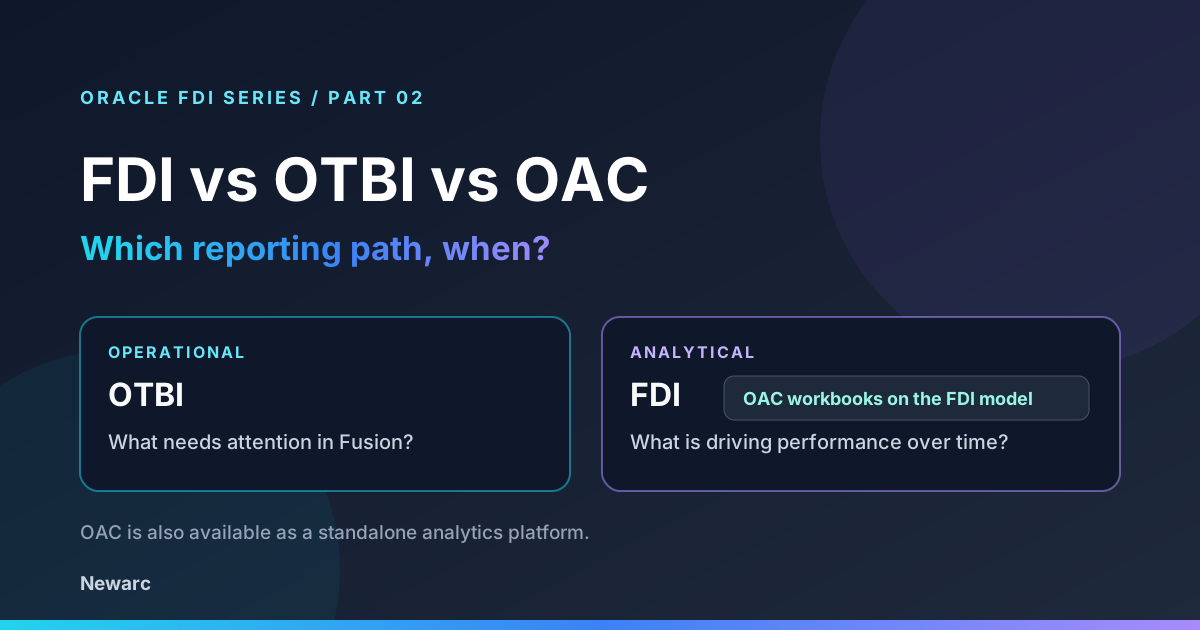
Use OTBI for operational questions about Fusion transactions. Use FDI for curated trends, enterprise KPIs and analysis across time and business areas. Treat OAC as the analytics platform that can work inside FDI or as a standalone service.
These tools have different jobs, so the useful decision is usually how to combine them. An accounts-payable analyst checking an invoice and a controller investigating six months of working-capital performance need different reporting paths.
This is Part 2 of the Oracle FDI series. If the names are still new, start with What Is Oracle Fusion Data Intelligence?, which explains the managed service and its architecture.
The decision rule: start with the business question
What does the reader need to do?
OTBI
Operational reporting through Fusion subject areas, with application security and current transaction context.
Which invoices need attention today?
FDI
Curated warehouse analytics, shared metrics and prebuilt Fusion analytical content.
What has driven working-capital changes over time?
OAC
Workbooks and analytics on the data and models supplied to the platform, including the FDI model.
How should analysts explore this governed dataset?
Oracle Analytics Publisher
Formerly BI Publisher (BIP). Formatted operational documents and reports with layout and delivery requirements.
Do we need a precisely formatted PDF or statement?
Oracle's Fusion Insider guidance separates day-to-day financial operations from enterprise analytics and from EPM's consolidation and planning responsibilities. The Oracle A-Team framework comparison makes the same operational-versus-analytical distinction for reporting design.
What the names mean
| Name | Meaning | Role in the reporting estate |
|---|---|---|
| OTBI | Oracle Transactional Business Intelligence | Embedded Fusion analyses and dashboards over transactional subject areas. |
| Oracle Analytics Publisher | Formerly Oracle Business Intelligence Publisher, commonly called BI Publisher or BIP | Formatted operational reports and documents. |
| FDI | Oracle Fusion Data Intelligence | Managed analytics applications, pipelines, warehouse, semantics and prebuilt content. |
| FAW | Fusion Analytics Warehouse | FDI's former name; still common in older documents and project discussions. |
| OAC | Oracle Analytics Cloud | Analytics and visualization platform, used by FDI and also available independently. |
| Fusion ERP Analytics | An application within the FDI family | Analytics content focused on finance, procurement and projects. |
Oracle Analytics Publisher is the current product name; BI Publisher and BIP are familiar legacy names for the same reporting product. Oracle explicitly lists those alternate names in its product documentation. Some Fusion documentation and connector labels still use the older terminology: for example, the FDI guide describes loading from Oracle Analytics Publisher while referring to the Oracle BI Publisher connector. See Oracle's Publisher connector guidance. Recognizing both names helps when following existing runbooks or searching older documentation.
Financial Reporting and Smart View also have roles in financial statements and Excel-based analysis. This guide focuses on choosing between operational Fusion reporting and the FDI/OAC analytics paths.
Oracle describes the FDI stack in its service overview. For OTBI analyses and dashboards, see the OTBI documentation hub and user guide.
Embedded Fusion reporting vs. FDI vs. OAC
The comparison below distinguishes a reporting capability, a managed analytical service and the platform on which analytical content can run.
| Dimension | Embedded Fusion, especially OTBI | Fusion Data Intelligence | OAC as a platform |
|---|---|---|---|
| Primary job | Day-to-day transactional reporting. | Curated enterprise analytics and prebuilt applications. | Data exploration, visualization and analytics. |
| Data foundation | Fusion transactional subject areas. | Replicated data in an analytics warehouse. | The connected data sources and models. |
| Freshness | Operational access to Fusion data; behavior depends on the subject area and query. | Depends on configured pipelines and successful refreshes. | Depends on the connection, model, cache and refresh design. |
| History and external data | Bounded by the application reporting model. | Designed for historical and cross-source analysis through supported extensions. | Possible with suitable connections and modeling. |
| Prebuilt Fusion content | Subject areas and application reporting content. | Packaged metrics, workbooks and analytical applications. | Does not provide the FDI application package by itself. |
| Security | Fusion roles and transactional data access. | FDI roles and configured data-security mappings. | Platform access and the security of the data/model. |
| Typical relationship | Supports operational users alongside analytics. | Adds a managed analytical foundation. | Provides the analytics experience within FDI or a standalone solution. |
The operational and analytical contrasts follow Oracle's framework guidance. The FDI service includes the managed foundation described in Oracle's architecture overview; standalone OAC has broader platform capabilities described in Oracle Analytics.
FDI dashboards should not be treated as a live view of each newly posted transaction. If someone must act on an invoice's current status, begin in the Fusion application or an appropriate OTBI analysis. For a trend or KPI, confirm the FDI data cutoff and use the analytical model.
Which reporting tool fits which question?
| If you need to answer or produce… | Start with… | Check before delivery |
|---|---|---|
| Which invoices or receivables need operational attention? | Fusion UI / OTBI | Appropriate subject area, status definitions and user access. |
| A formatted letter, document or statutory layout | Analytics Publisher (formerly BI Publisher) | Layout, source data and delivery requirements. |
| Working-capital trends, spend patterns or profitability drivers | FDI / Fusion ERP Analytics | Subscribed content, metric definitions, history and refresh cutoff. |
| A custom visualization using FDI subject areas | OAC workbooks within FDI | The governed model, selected measures and data-security mappings. |
| Analytics across a wider set of connected enterprise data | Standalone OAC or an FDI extension, according to the architecture | Data integration, modeling, governance and ownership. |
| Financial consolidation or planning | EPM | The business process and source integration; this is a separate design decision. |
For example, an AP analyst may use OTBI to identify an invoice requiring action. A finance manager may use FDI to investigate supplier-payment trends over several periods. An OAC workbook can visualize those FDI measures, but it does not make the underlying pipeline update more frequently.
The Fusion ERP Analytics product overview covers the financial, procurement and project-analysis use cases. The examples here are starting points for design, not a promise that every measure is present in every subscription.
Why freshness differs: the same transaction, two paths
Operational reporting and analytics read different foundations
Fusion UI / OTBI
Fusion Data Intelligence
FDI copies data into its analytical foundation through configured pipelines. The relevant question is when the required functional area last completed successfully, rather than whether an analyst has just reopened a workbook. Oracle documents the scheduling process in creating a functional-area pipeline.
When a dashboard appears to be missing a transaction:
- Confirm which functional area and source contain the transaction.
- Check the last successful refresh and the expected reporting cutoff.
- Inspect the workbook's filters, period, scenario and other point-of-view selections.
- Check the user's data access and the measure's business definition.
- Use the operational application or OTBI if the business action cannot wait for the analytical refresh.
Agree freshness requirements with stakeholders before building dashboards. A monthly trend pack and an urgent exception queue can both be useful without sharing the same data cutoff.
OAC inside FDI and standalone OAC are different designs
Inside FDI, OAC supplies the analytics experience on FDI's managed data and semantic model. Analysts can explore prebuilt content and develop custom workbooks within the supported framework.
Standalone OAC is an analytics platform on OCI. Its usefulness depends on the data connections, models, integration and governance designed around it. Connecting Fusion extracts to standalone OAC does not by itself reproduce FDI's managed pipeline, curated model or packaged Fusion applications.
| With OAC inside FDI | With standalone OAC |
|---|---|
| Start with the subscribed FDI analytical applications and managed foundation. | Design around the datasets and analytical models you provide. |
| Extend the FDI model through its supported customization framework. | Establish the appropriate connection, modeling and governance approach. |
| Validate FDI refreshes, business measures and security mappings. | Validate source freshness, data preparation, model definitions and platform access. |
Oracle's FDI overview describes the boundaries of semantic-model customization. Use that framework rather than assuming every standalone OAC modeling workflow applies to FDI's prebuilt model. The distinction is about the complete service architecture, not just which visualization screen the user sees.
When to combine the tools
For a Fusion finance team, a practical reporting design often has three complementary responsibilities:
- OTBI and Analytics Publisher (formerly BI Publisher): operational exceptions, transaction reporting and formatted documents.
- FDI with OAC: governed analytical measures, historical trends and cross-functional insight.
- EPM where needed: consolidation and planning processes, kept distinct from transaction processing.
This follows the separation described in Oracle's financial-analysis guidance. Decide which tool answers each question, then define how the numbers will be reconciled between them.
Validate before expanding the reporting estate
Choose a small set of representative measures and samples. Compare source and analytical results using the same business definition, currency, period and cutoff. Explain any expected timing differences before users interpret them as data defects.
Treat security as part of that validation. Verify what users can see in FDI; do not assume access will match an OTBI analysis without checking the mapped roles and data rules.
Use embedded reporting for its intended reporting workload. Large historical extracts and external-data integration need an appropriate data architecture. Oracle's A-Team guidance discusses those boundaries and recommends planning the FDI refresh design around the business requirement.
Newarc's recommendation
Start with the question, its owner and the required data freshness. Keep operational actions in the operational reporting path, use FDI for the analytical foundation, and make OAC's role in that design explicit. Agree metric definitions and a reconciliation process before scaling the number of dashboards.
Subscription considerations
Embedded reporting tools generally follow the relevant Fusion Applications entitlements; FDI requires a separate subscription. Standalone OAC is another offering. Confirm the subscribed applications, permitted data use and intended extensions with your Oracle account representative before finalizing scope.
Oracle described the FAW-to-FDI rename as a rebrand, with no customer action required for the naming change itself. See the Proactive Support announcement. A new name alone is not a reason to assume a new purchase, and it is also not evidence that every current feature is included in an older subscription.
Frequently asked questions
Is OAC the same as FDI?
No. Oracle Analytics Cloud is an analytics platform. Fusion Data Intelligence uses OAC together with managed pipelines, an analytics warehouse, a semantic model and prebuilt Fusion analytics content. Standalone OAC does not automatically include Fusion ERP Analytics.
Does FDI replace OTBI?
FDI complements OTBI. Use OTBI for operational reporting on Fusion transactions and FDI for curated analytics over time. Choose according to the question, data scope and freshness required.
Is FAW different from FDI for licensing?
Oracle described the FAW-to-FDI rename as a rebrand with no action required for the name change itself. Your entitlements still depend on the subscription and intended use; confirm them with Oracle.
Can I blend Salesforce or EBS data in OTBI the same way as FDI?
OTBI focuses on Fusion transactional subject areas. FDI supports loading additional sources into its analytics foundation through supported connection and extension patterns. Plan external-data blending in that architecture rather than assuming OTBI offers equivalent warehouse capabilities.
Why is my FDI dashboard not showing today's transactions immediately?
FDI analyzes data loaded into its warehouse through configured pipelines. Check the relevant functional area's last successful refresh, then the workbook's filters and point of view. Use Fusion or OTBI if the question requires current operational status.
Oracle sources and further reading
Product details checked on October 19, 2026. Sources include Oracle's operational-reporting guidance, current service documentation and product overviews.
- Get financial analysis right — Fusion Insider
- Choosing the Right Reporting Framework in Fusion Cloud Applications — Oracle A-Team
- About Oracle Fusion Data Intelligence — Oracle documentation, 26R3
- OTBI Get Started and Creating Analyses and Dashboards in OTBI
- Oracle Analytics platform overview
- Fusion ERP Analytics product overview
- Create a Data Pipeline for a Functional Area — Oracle documentation, 26R3
- Fusion Analytics Warehouse is now Fusion Data Intelligence — Oracle Proactive Support
- Oracle Analytics Publisher: current name and legacy titles
- Load Data from Oracle Analytics Publisher into FDI: legacy connector naming
Return to Part 1: What Is Oracle Fusion Data Intelligence? for the stack and product-family overview. Later articles in this series will cover FDI with Fusion ERP and semantic-model basics; they appear as upcoming topics in the series navigation.