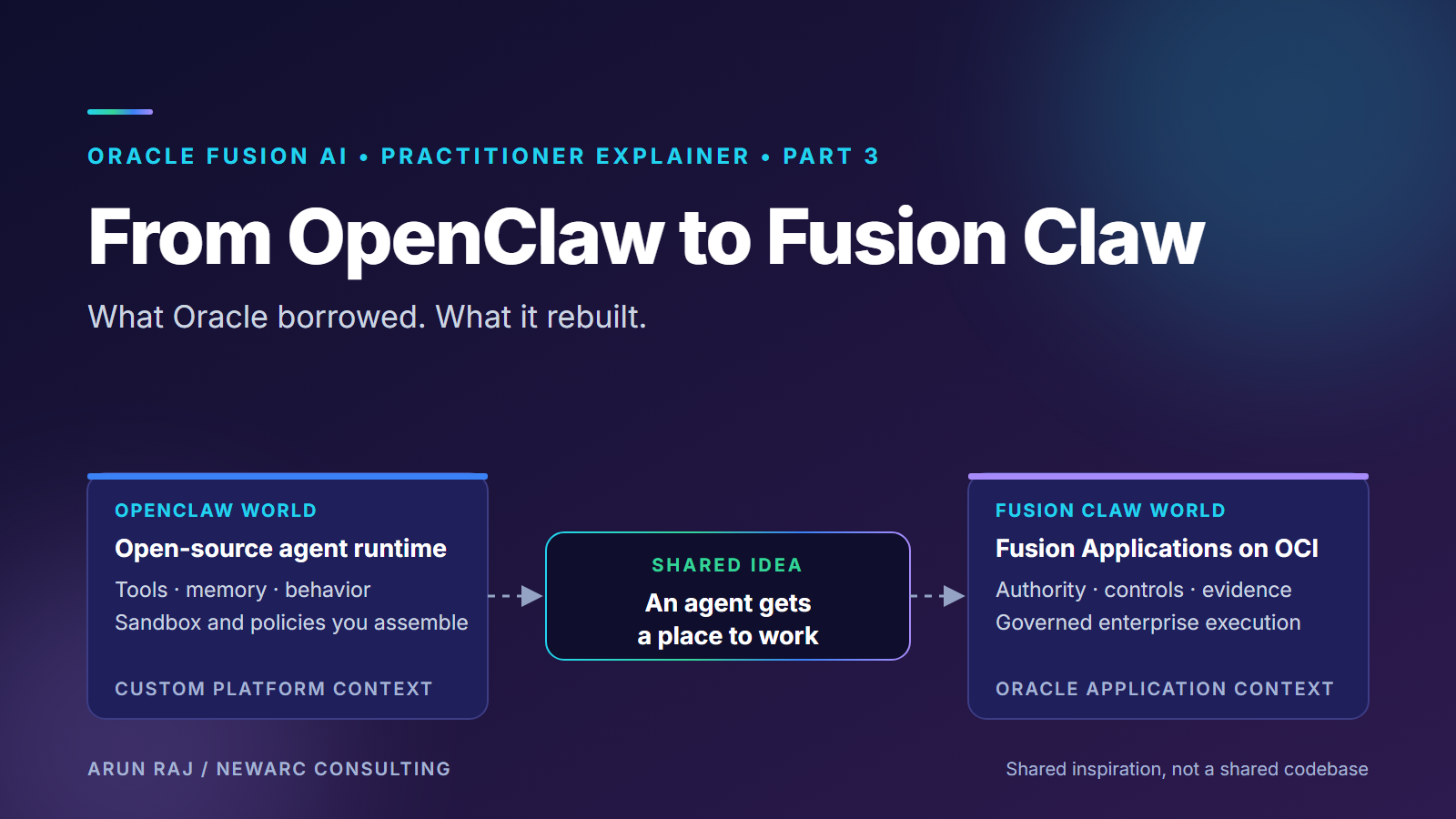
Practitioner explainer, Part 3. Oracle practitioners keep asking the same question after the September 29 announcement: is Fusion Claw just OpenClaw running inside Fusion? The short answer is no. The longer answer is more useful. Oracle borrowed a powerful idea—give an agent an isolated place to work—and rebuilt the surrounding architecture for Fusion Applications on OCI. [1] [2]
This article is a borrow/rebuild map for ERP and EPM teams. It is not a product catalog, and it is not a claim that Fusion Claw is a fork of OpenClaw.
A companion to Fusion Claw Explained and Part 2: The Execution Environment.
Why the naming confusion is understandable
OpenClaw made “Claw” a recognizable label for agents that do more than chat. When Oracle announced Fusion Claw, many practitioners heard the shared name and assumed a shared codebase. Natalia Rachelson told TechTarget that Fusion Claw was inspired by OpenClaw but differs in focusing on enterprise rather than consumer applications. Independent reporting has also described Fusion Claw as OpenClaw-inspired and built for Oracle’s own architecture. [4]
Inspiration and identity are different things. For implementation planning, that distinction matters more than the brand overlap.
What OpenClaw is, at a high level
OpenClaw is an open-source agent runtime. In plain language, it gives an agent a computing environment—a workspace where it can plan work, use tools, keep memory, and carry out tasks over time. That “agent gets a computer” idea is the conceptual bridge Oracle executives have acknowledged when discussing Fusion Claw’s inspiration. [5]
Practitioners evaluating custom agent platforms often encounter a related sandbox and policy stack:
Three projects. Different jobs.
The assistant/runtime inside a container: tools, memory, and agent behavior.
Sandbox lifecycle, network/filesystem/process policy, and inference routing.
Host-side orchestration and onboarding that stands up OpenClaw inside OpenShell with hardened defaults.
Those projects are not Oracle products. They show how the open-source world answers a familiar question: how do you let an agent work productively without unconstrained host access? OpenClaw popularized a pattern. Oracle applied that pattern’s idea inside Fusion Apps.
What Oracle borrowed conceptually
If you strip away product branding, several borrowed ideas show up clearly in Oracle’s public framing and in reporting on interviews with Oracle leadership:
An isolated place to work
The agent does not wander the open internet with your ERP credentials. It works inside a bounded runtime.
Plan, then execute
A frontier model reasons about the objective and assembles a plan; execution follows as a more deterministic, repeatable step.
Longer-running specialist work
The target is not a single question-and-answer turn. It is multi-step work that may take many rounds.
Reuse of successful plans
Once a customer-approved plan works for a class of assignments, similar work can reuse that structure rather than re-deriving everything from scratch.
Frontier models for reasoning
Gemini, OpenAI, and planned additional models handle the interpretive work.
Separation of “think” and “do at scale”
Reasoning is applied where judgment is needed. High-volume calculation and validation stay with deterministic enterprise computation.
Those are conceptual borrowings. They explain why the OpenClaw analogy resonates. They do not mean Fusion Claw is OpenClaw packaged for Fusion.
What Oracle rebuilt for Fusion
A workspace is the starting point. The operating context changes.
Oracle rebuilt the surrounding system so the runtime fits Fusion Applications as the system of record, OCI as the platform, and enterprise governance as a first-class design requirement.
A governed runtime inside Fusion on OCI
Fusion Claw is Oracle’s governed agentic execution runtime for Fusion Agentic Applications. Customers do not stand up their own OpenClaw deployment, wire OpenShell policies, and then point that stack at Fusion APIs. The runtime is designed to run inside Fusion on OCI. Forbes reporting on Chris Leone’s interview describes an orchestration agent in an isolated runtime container inside Fusion—without a separate customer-managed agent environment as the primary path. [2]
That rebuild changes who owns the hard parts: tenancy, identity integration, tool assembly against Fusion capabilities, and the audit trail that finance and internal audit will eventually ask to see.
Claw-powered Agentic Applications as the customer-facing unit
Most Fusion customers will not “buy Claw” as a standalone sandbox product. They encounter Claw through Claw-powered Agentic Applications. Oracle’s launch named Ledger, Workforce Staffing, Shipping Consolidation, and Account Territory Growth Plan among the initial examples, and positioned 25 Claw-powered applications within a broader portfolio of Fusion Agentic Applications. [1]
Oracle documentation also shows Claw-powered workspaces such as Procurement Spend Command Center and Collector Workspace—proof points for continuing specialist assignments, not an exhaustive catalog. [3]
Governance vocabulary already covered in Parts 1 and 2
Oracle’s launch language centers on three named concepts: the Enterprise Operating Envelope, the Outcome Trust Harness, and the Outcome Receipt. I covered those in Part 1 and will not redefine them here. For this article, the rebuild point is enough: Oracle did not stop at “agent in a container.” It named a governance model that finance, security, and audit can map to familiar control conversations. [1]
SOPs, research mode, and automation dial
Oracle’s Fusion Claw capabilities documentation notes that Fusion Claw can incorporate standard operating procedures to guide analysis and actions in the customer’s enterprise context. That is a meaningful rebuild for ERP teams. An agent that ignores close procedures is not useful, even if it can call the right APIs. [3]
Public reporting also describes a research mode that stages proposed actions for human review, alongside fuller automation within delegated authority. Oracle’s announcement similarly says customers can choose a level of automation ranging from assistance to governed full-auto execution. The practical message for practitioners: autonomy is a dial, not a binary switch flipped at go-live. [1] [2]
Autonomy is a dial.
Oracle describes a range from assistance to governed full-auto execution. Select a position to explore what changes.
The application assists with analysis and recommendations; people decide which actions to take.
Objectives, permissions, policy, and accountability still matter at every position.
Builder and Agent Studio ecosystem
Fusion Claw sits inside a broader Fusion AI ecosystem anchored by Oracle AI Agent Studio for Fusion Applications, including Agentic Applications Builder capabilities. Partners and customers can create and manage agentic applications using reusable Oracle, partner, and external agents. That ecosystem framing matters because Claw is not only a set of shipped applications; it is an execution approach those applications—and future built applications—can use. [1]
Comparison: OpenClaw world vs Fusion Claw world
| Dimension | OpenClaw world (incl. OpenShell / NemoClaw context) | Fusion Claw world |
|---|---|---|
| What it primarily is | Open-source agent runtime and optional sandbox/orchestration stack | Governed agentic execution runtime for Fusion Agentic Applications |
| Deployment | Customer- or platform-managed; often container/sandbox based | Inside Fusion Applications on OCI |
| Tenancy / ops ownership | You (or your platform team) operate the agent host and policies | Oracle operates the Fusion/OCI runtime path; customer configures objectives, authority, and application use |
| Who defines tools | You attach tools, MCP servers, channels, and skills | Fusion capabilities and Claw-powered Agentic Applications; Builder/Agent Studio for extensions |
| Governance model | Policy/sandbox controls you assemble (OpenShell policy, host controls, etc.) | Enterprise Operating Envelope, Outcome Trust Harness, Outcome Receipt (see Part 1) |
| Primary audit artifact | Whatever logs, traces, and receipts your stack records | Outcome Receipt as the named auditable record of authority, evidence, decisions, actions, and result |
| Primary audience | Builders of custom assistants and agent platforms | Fusion ERP/HCM/SCM/CX practitioners pursuing business outcomes in Fusion |
| Relationship | Inspiration and parallel ecosystem | Inspired by the “agent computing environment” idea; not presented as an OpenClaw fork |
Practitioner takeaway: when each pattern matters
Use the OpenClaw / OpenShell / NemoClaw pattern when you are building or evaluating a custom agent platform—for example, an internal assistant that works across documents, tickets, and selected enterprise APIs outside a single SaaS runtime. In that world, you own sandbox policy, credential handling, tool inventory, and the audit story.
Use Fusion Claw when the outcome lives in Fusion Applications and you want governed, longer-running specialist work against Fusion as the system of record. Ledger close-readiness investigation, staffing plan execution under labor constraints, or procurement spend exception handling are the kinds of assignments that belong in that conversation.
Do not confuse the names. They share a metaphor and a conceptual lineage, not an implementation claim for architecture review. If a slide says “OpenClaw inside Fusion,” ask for the deployment model, the governance artifact, and whether Fusion remains the system of record.
What this means for EPM teams reading this series
Fusion Claw, as announced, is about Fusion Agentic Applications. It does not, by itself, announce a generally available “EPM Claw” runtime for every Planning, FCC, reconciliation, or Data Management process. Separately, Oracle’s Fusion AI portfolio continues to list EPM-oriented agents. The boundaries still need confirmation for any implementation.
The useful move for EPM practitioners is to treat Fusion Claw’s governed execution pattern as a design reference, then ask which EPM assignments could follow the same reason → check authority → invoke a narrow capability → verify → retain evidence sequence. That is the subject of the next article in this series: a conceptual “Oracle EPM Claw” design pattern—explicitly labeled conceptual, not GA.
A governed sequence to evaluate
- 01ReasonUnderstand the assignment
- 02Check authorityApply the operating boundary
- 03InvokeUse a narrow capability
- 04VerifyAssess the result
- 05Retain evidenceKeep the audit trail
If you are still framing the Fusion side of the architecture, start with Part 1 for Envelope / Harness / Receipt, and Part 2 for long-running assignments and the reasoning↔deterministic handoff.
OpenClaw vs Fusion Claw FAQs
Is Fusion Claw OpenClaw running inside Oracle Fusion?
No. Fusion Claw is presented as Oracle’s governed agentic execution runtime for Fusion Agentic Applications on OCI. OpenClaw inspired the agent computing environment idea; that does not establish a shared implementation or an OpenClaw fork.
What did Oracle borrow from the OpenClaw idea?
The conceptual bridge is an isolated computing environment where an agent can plan and carry out work. The article also maps related ideas such as longer-running assignments, plan reuse, and the separation of reasoning from deterministic execution. This is an architectural interpretation, not a code compatibility claim.
Who operates the Fusion Claw runtime?
The runtime path is designed for Fusion Applications on OCI rather than a separate customer-managed OpenClaw deployment. Customers define objectives, delegated authority, and application use. Exact operational responsibilities and availability should be confirmed for the customer’s tenancy.
Does Fusion Claw mean there is a generally available EPM Claw?
The Fusion Claw announcement concerns Fusion Agentic Applications. It does not by itself establish a generally available EPM Claw runtime for Planning, FCC, reconciliation, or Data Management. The next article’s EPM pattern is conceptual and should be evaluated separately from released product capabilities.
Sources and scope
- Oracle, Oracle Extends Fusion Agentic Applications with Introduction of Fusion Claw, September 29, 2026. Primary source for the Fusion Claw runtime description, governance concepts, and named application examples.
- Victor Dey, Forbes, Oracle Fusion Claw Adapts OpenClaw’s Agentic AI Approach For Enterprises, September 29, 2026. Includes interview themes with Oracle EVP Chris Leone on isolated runtime design, plan reuse, and OpenClaw inspiration.
- Oracle documentation, Fusion Claw Capabilities. Source for SOP guidance, documented Claw-powered workspaces, and outcome framing.
- David Essex / Natalia Rachelson, TechTarget, Oracle Fusion Claw: the new grab for fully autonomous agentic AI in ERP, September 29, 2026. Source for Rachelson’s statement that Fusion Claw was inspired by OpenClaw but differs for enterprise vs consumer focus.
- NVIDIA / OpenClaw ecosystem documentation for open-source context only: NemoClaw ecosystem and OpenClaw OpenShell backend. These are not Oracle products.
- Prior Newarc posts: Fusion Claw Explained and Fusion Claw, Part 2.
The comparison table and practitioner guidance are the author’s interpretations for ERP/EPM teams. They should not be read as an Oracle product architecture diagram, an OpenClaw compatibility claim, or a configuration guide. Availability, licensing, and exact runtime behavior should be confirmed against current Oracle release notes for your tenancy.