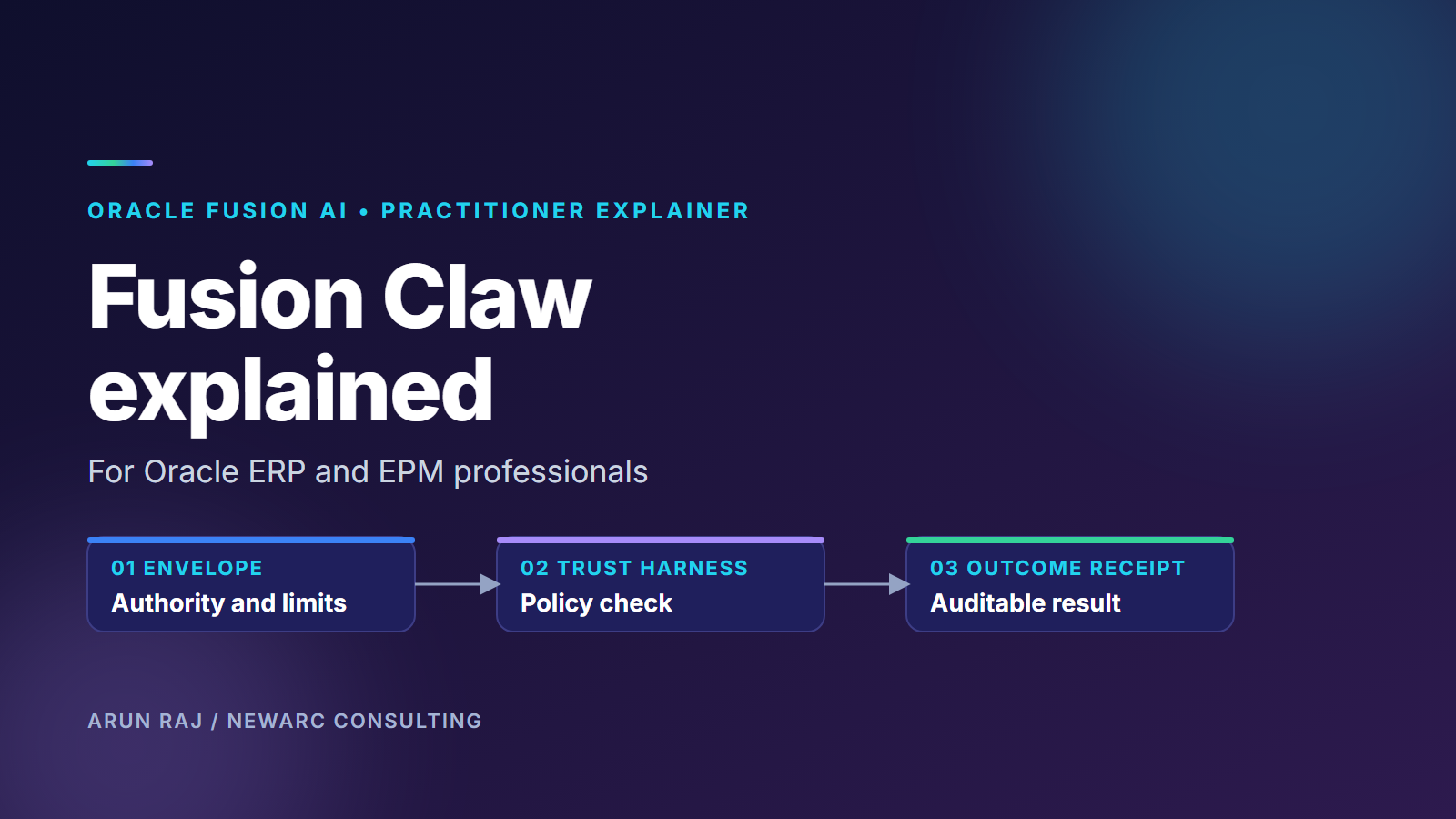
Practitioner explainer. Oracle is moving from agents that answer questions and call tools toward applications that pursue business outcomes within delegated authority. Here is the architecture that matters for finance and EPM teams.
Oracle describes Fusion Claw as a governed agentic execution runtime for Fusion Agentic Applications. The phrase matters: a runtime must coordinate work, enforce boundaries, execute actions and record results. It does more than generate an answer.
For ERP and EPM professionals, the key question is no longer simply what an agent can do. It is which outcome we would delegate, under whose authority, with what checks and evidence. Those are familiar questions from financial controls and systems architecture, now applied to software that can reason and act.
From assistance to accountable outcomes
Generative AI can summarize a variance or draft an explanation. A tool-using agent can query a balance, inspect a journal or start a workflow. An agentic application can coordinate several capabilities around a continuing business objective: detect an exception, investigate it, calculate a remedy, seek approval, act and verify the result.
“What work are we willing to delegate to an AI system, under what authority, and with what controls?”
That shift is especially consequential in finance. A well-formed outcome is measurable, but the path to it may change as evidence arrives. The system needs room to reason without acquiring unlimited authority to post, update or approve transactions.
Where Fusion Claw fits
AI Agent Studio is the environment in which teams build and manage agents, tools and agentic applications. Fusion Agentic Applications are the business-facing applications pursuing outcomes across Fusion domains. Fusion Claw is Oracle’s named governed execution runtime. Fusion Applications remain the transactional system of record. The diagram below is a conceptual map, not an official Oracle system diagram.
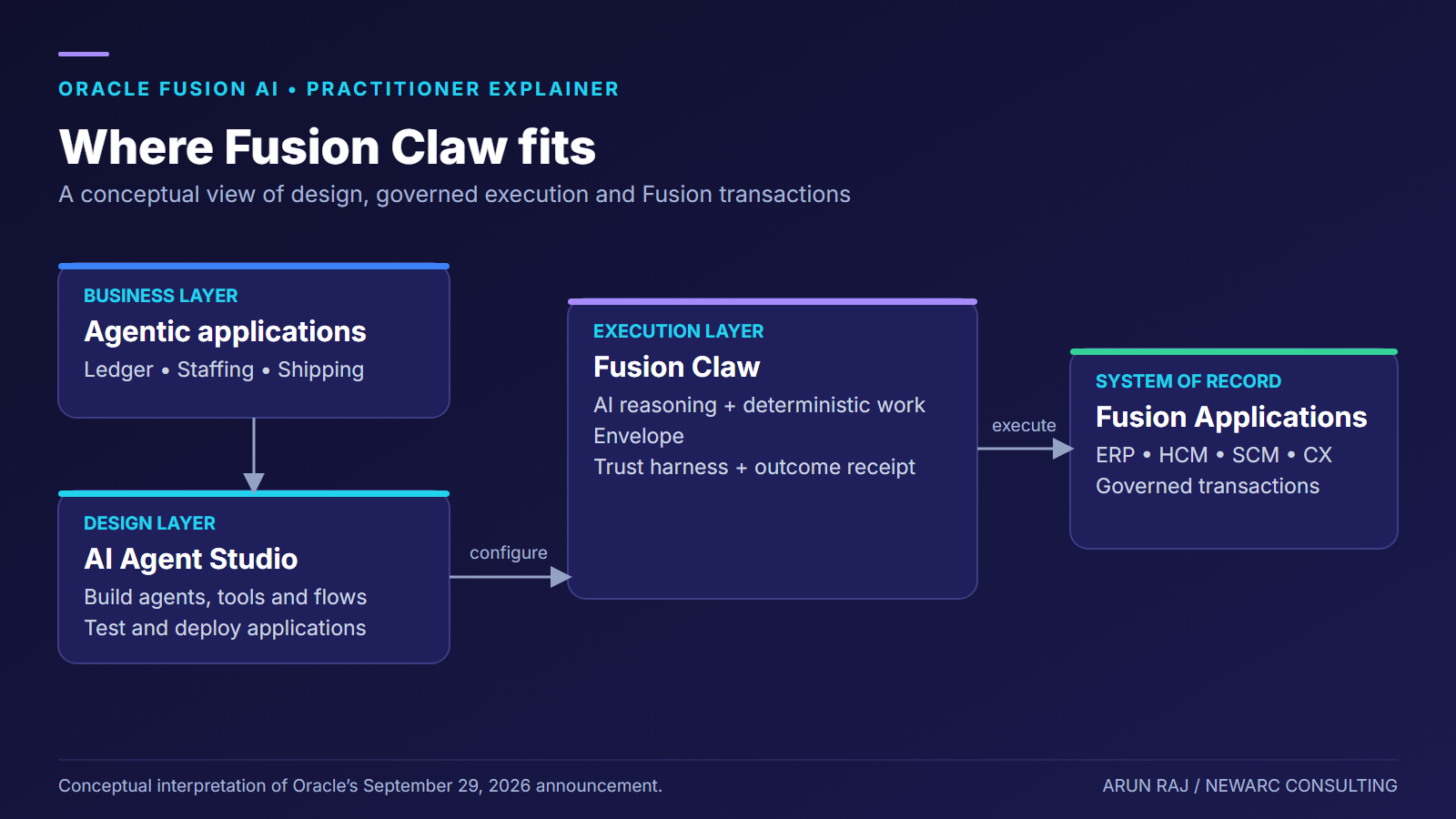
Oracle’s announcement highlighted a Ledger application along with workforce staffing, shipping consolidation and territory growth examples. It described 25 Claw-powered applications in the initial set and 75 Fusion Agentic Applications in the broader portfolio. Those counts and availability claims come from the launch announcement and should be checked again before a later publication date.
Why deterministic computation matters
Oracle emphasizes a combination of AI reasoning and deterministic enterprise computation. The distinction is crucial. A model can help interpret an exception, choose a line of inquiry or explain competing options. Accounting calculations, reconciliation matching, validations and transaction posting need predictable services with established controls.
| Reasoning is useful for | Deterministic services should handle |
|---|---|
| Investigating an unexpected balance | Retrieving and aggregating ledger data |
| Choosing evidence to inspect next | Matching transactions under defined rules |
| Drafting an exception explanation | Calculating, validating and posting corrections |
| Replanning when conditions change | Executing approved business rules and workflows |
The model can coordinate the process. It should not improvise the mathematics of consolidation, depreciation, currency conversion or Planning calculations.
The operating envelope, trust harness and receipt
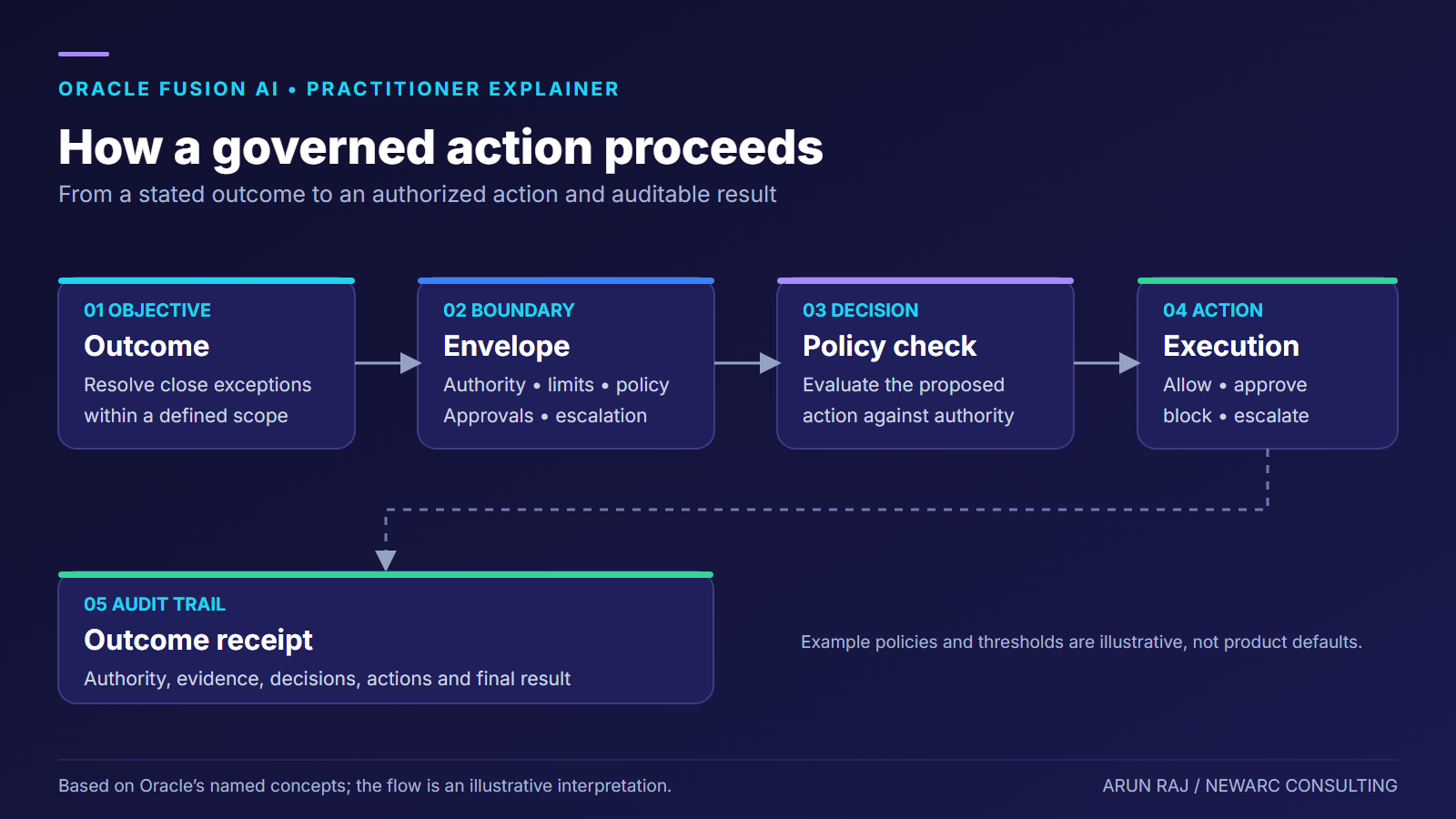
Three named concepts make the governance story concrete. The Enterprise Operating Envelope describes objectives, permissions, constraints, decision rights, risk thresholds, approvals and escalation boundaries. The Outcome Trust Harness evaluates the agent’s identity, capabilities, data, actions and authority. The Outcome Receipt records the authority, evidence, decisions, actions, transactions and result.
An illustrative finance policy
An agent may investigate all open-period exceptions in an assigned ledger. A correction under $5,000 with an approved pattern may be eligible for execution. Larger or ambiguous items require controller review. Closed periods and restricted ledgers are outside its authority. The $5,000 threshold is an example, not an Oracle default.
Capability and authority are different. An agent might be technically able to call a journal API while a policy still blocks the action for a particular ledger, amount, period or user. The receipt makes the delegated work reviewable after the fact; for audit teams, the evidence chain may be as important as the final status.
What ERP teams should design
The Ledger example suggests a close process that moves from periodic report chasing toward continuous exception monitoring, investigation and authorized action. Oracle’s current Fusion AI page describes a Ledger Agent that can provide contextual inquiry and explanation and autocreate adjustment journals. The exact scope available to a customer still depends on product release, configuration, permissions and controls.
ERP design workshops should therefore specify the outcome and its boundary alongside the familiar process map:
- Which decisions may the agent make, and which transactions may it execute?
- Which ledger, business unit, period and monetary limits apply?
- What evidence must support a recommendation or transaction?
- Who approves exceptions, and what happens when policies conflict?
- How is a failed or partially completed action recovered and audited?
This turns agent design into a joint conversation among finance process owners, security, audit and implementation teams.
What it means for Oracle EPM
The September 29 Fusion Claw announcement concerns Fusion Agentic Applications. It does not, by itself, announce an “EPM Claw” runtime for every Planning, FCCS or Account Reconciliation process. Separately, Oracle’s Fusion AI portfolio page lists EPM agents for Account Reconciliation, Planning and Profitability and Cost Management. The product boundaries and licensing should be confirmed for any implementation.
The architecture nevertheless offers a practical design pattern. An Account Reconciliation agent could identify high-risk items, gather evidence, draft explanations and route exceptions. Planning could use reasoning to explore scenarios while existing EPM calculations and business rules produce the numbers. FCCS could use similar coordination for close monitoring, with consolidation and journal processing left to established services.
For an EPM team building its own agent, the safe conceptual sequence is: reason about the next step → check policy and authority → invoke a narrow EPM capability → verify the result → retain an audit record. This is an architectural inference inspired by Fusion Claw, not a claim that Oracle has shipped that same runtime for EPM.
Where MCP fits
MCP can expose capabilities such as get_job_status, retrieve_data or run_business_rule to an agent. It helps the agent discover and invoke tools. An enterprise implementation must also decide whether an invocation is permitted in this context, whether it needs a person’s approval, how it is executed and how its result is recorded.
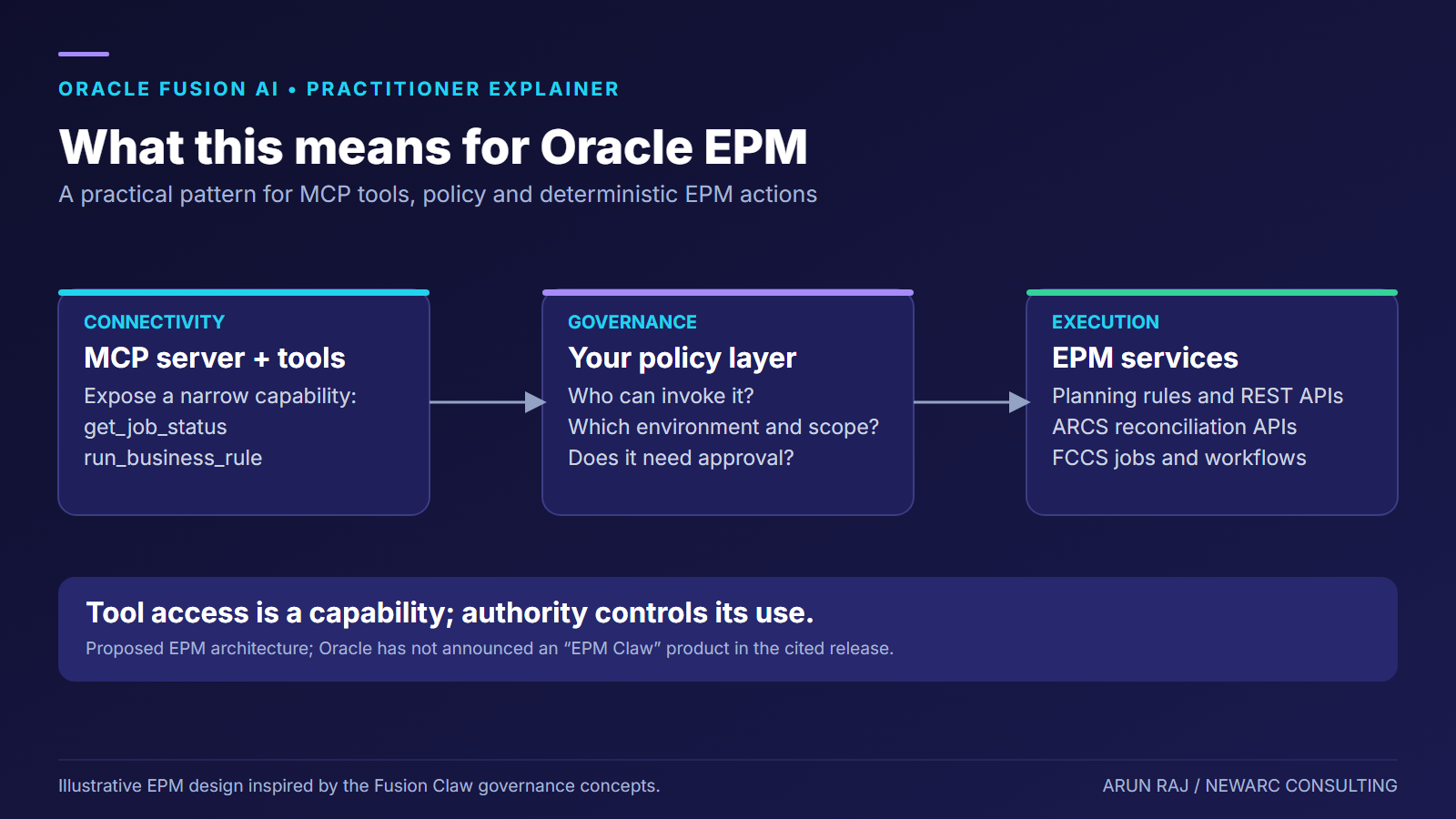
Oracle’s broader Fusion AI page lists MCP and A2A interoperability among its AI Agent Studio capabilities. That does not make MCP and Claw interchangeable. Connectivity exposes the operation; governed execution controls its use. For an EPM MCP server, small, explicit tools and an external policy layer are a more tractable starting point than granting one agent unrestricted administrative APIs.
A practical starting point
Pick one bounded, observable workflow. For example, let an agent monitor and explain reconciliation exceptions before allowing updates. Define the ledgers, periods, data access, evidence requirements, escalation route and measures of a correct outcome. Then add low-risk actions with approval and audit records. Test policy conflicts, stale data and partial failures as seriously as the happy path.
The lasting lesson is that enterprise agents require more than a model and tools. They need delegated authority, predictable execution and evidence that an accountable person can review. Fusion Claw gives Oracle ERP practitioners a vocabulary for designing that system, while EPM teams can apply the same principles to their own carefully scoped automation.
Sources and scope
- Oracle’s Fusion Claw launch announcement, September 29, 2026, distributed by PR Newswire. Source for the named Claw concepts and launch examples.
- Oracle AI for Fusion Applications. Source for the current portfolio descriptions, EPM agent listings and Agent Studio capabilities.
- Oracle AI Agent Studio documentation. Source for build, configuration and deployment context.
The architecture drawings and example policies are explanatory interpretations by the author. They should not be used as a product configuration guide or a representation of undocumented Oracle internals.
Arun Raj is the founder of Newarc Consulting, an Oracle ERP and EPM consultancy.