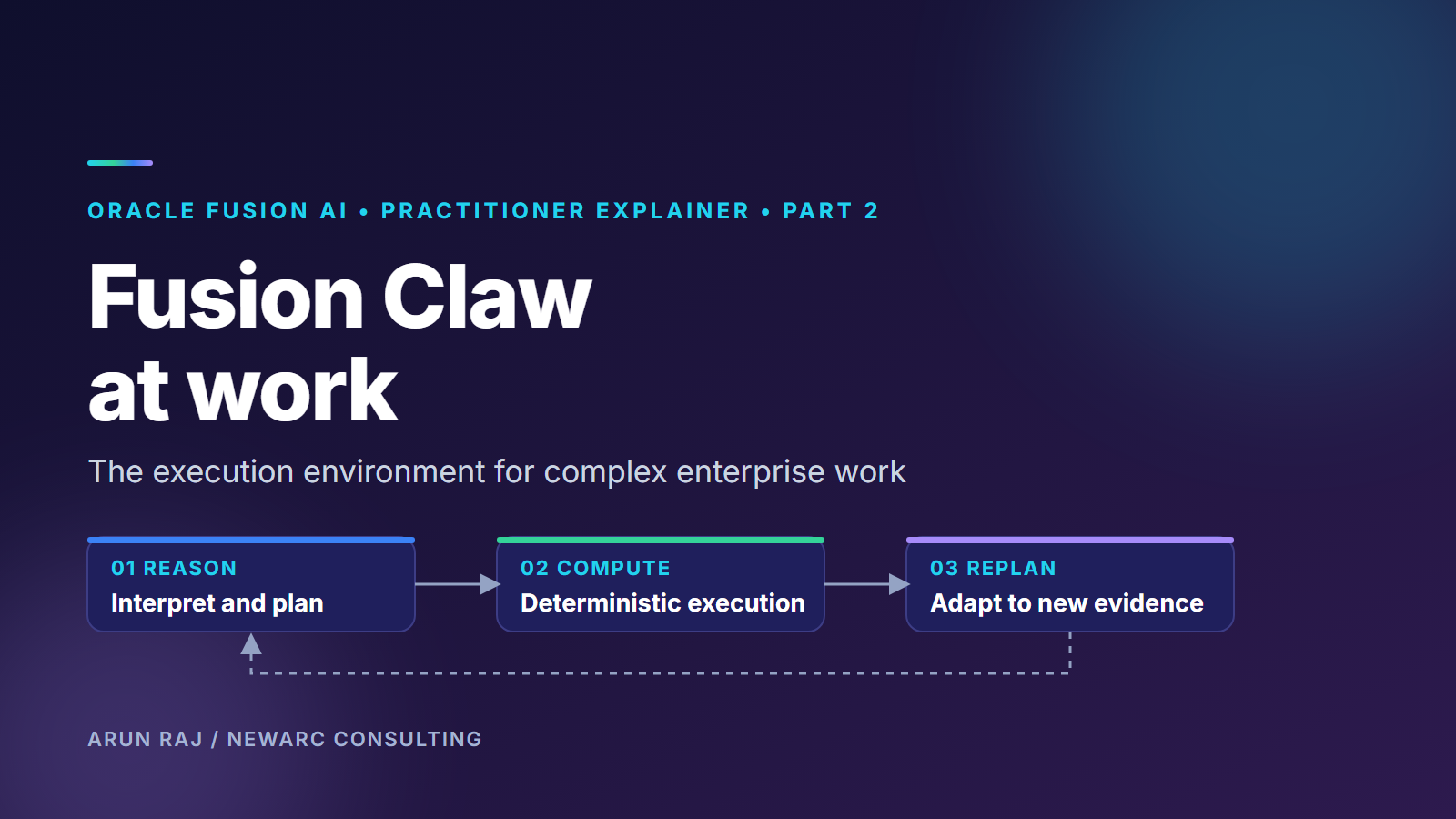
Practitioner explainer, Part 2. Research, optimization, reconciliation, simulation, modeling and computation, coordinated through an adaptive plan within delegated authority.
A companion to Fusion Claw Explained for Oracle ERP/EPM Professionals. This second article explores the work the execution environment can support.
In Part 1, I focused on delegated authority, policy enforcement and auditability. Those controls explain how autonomous enterprise work can be governed. There is another dimension to explore: the breadth and duration of the work itself.
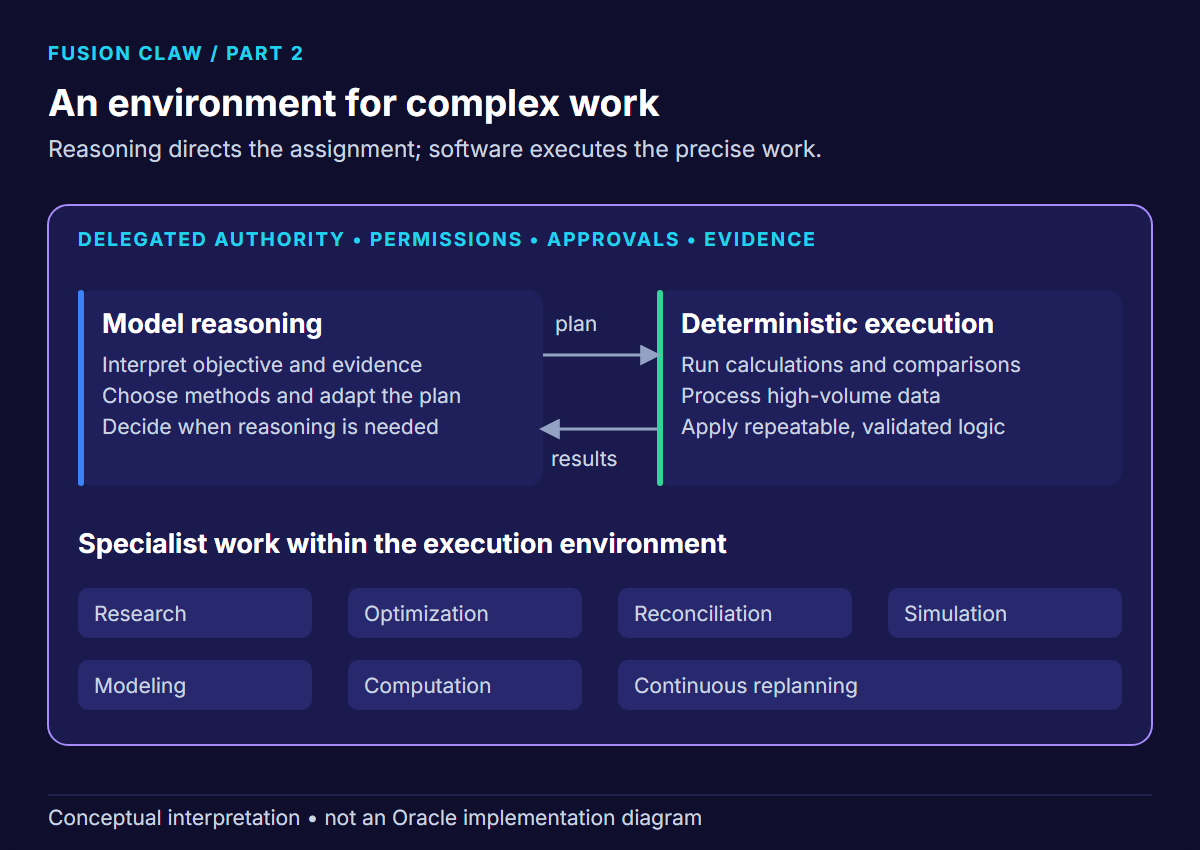
The feedback I received on the first article made that point clearly. Claw is designed to support complex, long-running assignments involving research, optimization, reconciliation, simulation, modeling, computation and continuous replanning. The model reasons about the objective and adapts the plan; deterministic software carries out high-volume and precision-sensitive execution within the governance layer.
What an execution environment enables
Oracle’s September 29 announcement describes larger-scale, longer-running specialist work, with model reasoning directing deterministic enterprise computation. It identifies a potential economic advantage from using reasoning where needed and efficient computation for volume. Its named examples span Ledger, Workforce Staffing, Shipping Consolidation and Account Territory Growth Plan. [1]
For a practitioner, the useful unit of design becomes an assignment. “Assess these exceptions and bring the assigned ledger closer to close readiness” is an assignment. So is “compare feasible staffing alternatives, select a supported option, and respond to coverage changes.” Each may require several methods, several rounds of analysis and a decision about when the objective has been satisfied.
A system needs to carry the objective and relevant evidence through those rounds. Its plan may need revision after a calculation, a new document or a changed constraint. That is a useful way to understand the execution environment. The public announcement does not specify all of its implementation details, such as persistence, checkpointing or recovery guarantees.
An isolated place to execute the assignment
Victor Dey’s Forbes article adds detail through an interview with Oracle EVP Chris Leone. It describes an orchestration agent in an isolated runtime container inside Fusion on OCI, without a separate customer environment. The agent builds a plan and assembles tools; the compute layer executes them as a codified artifact. [2]
The article connects the design’s inspiration to OpenClaw’s idea of giving an agent a computing environment. That describes inspiration, rather than establishing that Fusion Claw runs OpenClaw or shares its implementation.
Forbes also reports a research mode that stages proposed actions for human review, and reuse of customer-approved successful plans for similar assignments. Leone claims reasoning-cost reductions above 50%; the article notes that supporting benchmarks and Claw-specific pricing were not provided. That claim should not be treated as a guaranteed reduction in customer bills. [2]
Seven kinds of work, one assignment
The breadth becomes clearer when we map these capabilities to practical tasks. The following are illustrative interpretations, rather than a list of separately documented Claw tools.
| Work | What it could contribute to an assignment |
|---|---|
| Research | Gather relevant records and supporting explanations; identify gaps in the evidence. |
| Optimization | Search for feasible alternatives under constraints such as cost, capacity and service levels. |
| Reconciliation | Compare related data sets, apply matching logic and isolate exceptions for investigation. |
| Simulation | Test the consequences of a proposed change before committing to it. |
| Modeling | Represent relationships and assumptions so alternatives can be evaluated consistently. |
| Computation | Run aggregations, validations and repeatable calculations over many records. |
| Continuous replanning | Revise the next steps when results or operating conditions change. |
These activities can overlap. A reconciliation assignment may need research to explain an unmatched item, computation to quantify its impact, and simulation to assess a proposed correction. An optimization assignment needs a model, repeatable evaluation and a way to recognize when its input assumptions have changed.
That combination expands the kinds of applications we can imagine. The application can coordinate an investigation or evaluate alternatives before it reaches a transaction decision. The business value may come from resolving uncertainty as much as from automating the final action.
The handoff between reasoning and computation
Consider a hypothetical assignment to evaluate 10,000 allocation scenarios. A model might interpret the objective, select relevant constraints and identify a suitable evaluation method. A deterministic service can then apply that method across the scenarios. The model can review the resulting summary, investigate surprising outcomes and decide whether the approach needs revision.
There is no need to ask the language model to independently calculate every scenario. The reasoning effort can focus on choices that need interpretation, while software handles repeated arithmetic and comparisons.
An economic mechanism, not a savings guarantee
Reducing unnecessary model calls could improve the economics of a workload. Actual cost and latency depend on the models, data volume, computation, retries and implementation. No percentage saving is implied here. A useful evaluation would compare total cost, elapsed time and business-result quality for the same assignment.
“Deterministic” also requires care. Software can calculate a bad assumption consistently. Precision in execution does not establish that a business model is valid or that its inputs are complete. Teams still need to validate formulas, reconcile source data and test constraints.
Long-running work needs a feedback loop
Some assignments can be completed from one stable set of inputs. Others unfold while the business continues to change. New accounting entries arrive. A required employee becomes unavailable. A shipment misses a planned window. A recommendation that was feasible earlier may no longer satisfy the objective.
A useful design loop is to reason about the available evidence, execute the chosen work, evaluate the result and revise the plan if necessary. It should also have clear completion and escalation conditions. Continuing indefinitely is not a business outcome.
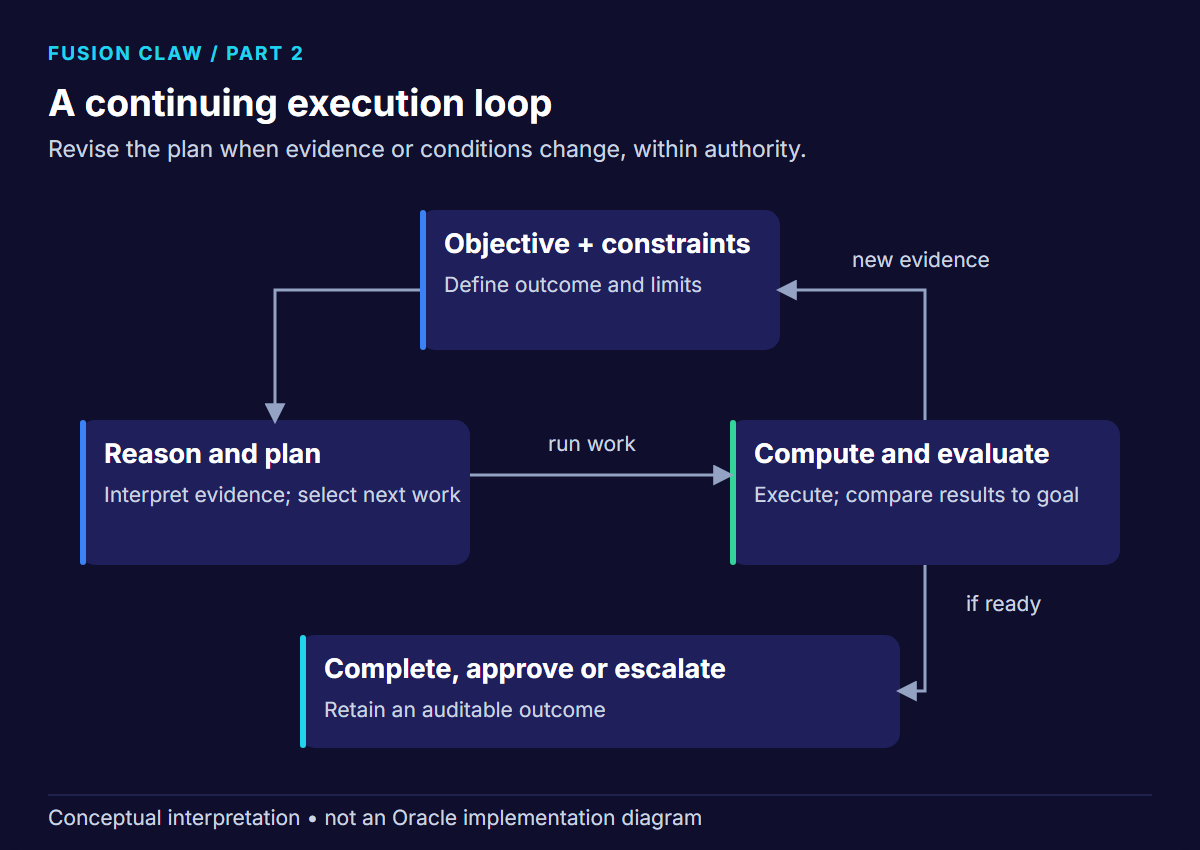
Replanning does not expand authority. If a new constraint makes the approved plan impossible, the next step may be an escalation rather than a more aggressive action. In a finance process, an agent should not acquire permission to reopen a closed period merely because doing so would make an exception easier to resolve.
A worked finance example
Imagine an application assigned to investigate open-period accounting exceptions for a defined ledger before a close deadline. The sequence below is an illustrative application design, not a specification of the shipped Ledger application.
- Establish the scope. Identify the authorized ledger, period, exception types, deadline and approval requirements.
- Gather evidence. Retrieve relevant entries and supporting records. Flag incomplete evidence rather than treating missing data as an explanation.
- Compute the exception picture. Use repeatable logic to reconcile records, calculate differences and group items for investigation.
- Investigate and test alternatives. Use reasoning to select further evidence or propose a remedy. Evaluate its expected effect before any authorized transaction.
- Respond to changes. If new entries arrive or a proposed correction fails validation, update the analysis and revise the plan.
- Act and verify. Execute within delegated authority or request approval. Confirm the actual result and retain evidence of what happened.
The assignment can therefore include investigation, reconciliation, computation and repeated evaluation. A journal action is one possible step within that work. A valid result might also be a well-supported escalation showing why an exception cannot yet be resolved.
How EPM consultants can use this pattern
For EPM practitioners, the same division of labor offers a design principle: reasoning coordinates the assignment while established calculation and integration services produce and validate the numbers. The examples below are hypothetical EPM applications; they do not assert that Fusion Claw is available as an EPM runtime.
Planning: investigate and compare feasible scenarios
An assignment could evaluate ways to reduce operating expense while protecting specified hiring commitments. The agent gathers assumptions, identifies candidate drivers and asks existing Planning rules to calculate scenarios. It compares the results to constraints and requests revised assumptions where necessary. A changed hiring decision could trigger another evaluation. Publishing an approved forecast remains a separately governed action.
Account Reconciliation: carry an investigation forward
An assignment could collect evidence for a high-risk reconciliation, quantify the outstanding difference and propose an explanation. If another source file arrives, the analysis can be revisited. Evidence gathering and drafting are different permissions from updating or certifying a reconciliation; those boundaries should be explicit.
FCCS: coordinate exception investigation
A close investigation could track selected consolidation exceptions, retrieve status and compare supporting data. Existing consolidation logic performs the calculations. The agent coordinates investigation and escalation around the results. It needs completion criteria and a clear response when the available evidence cannot support a conclusion.
What to specify before building
Start with an assignment brief that names the measurable result, relevant constraints, allowed services and decision owner. Then define what happens when evidence changes, approvals take time or only part of the assignment succeeds.
- Evidence: Which inputs were used, how current were they, and which assumptions affected the result?
- Execution: Which calculations and validations can be repeated safely?
- Replanning: Which changes justify another round, and when should the work stop?
- Authority: Which actions are delegated, which need approval, and which are prohibited?
- Evaluation: Did the assignment produce a correct, useful outcome at an acceptable cost and duration?
These are implementation questions to ask of any long-running enterprise agent. They should not be read as undocumented guarantees about Claw’s internal behavior.
The opportunity for Oracle professionals
Part 1 explored the controls around autonomous action. Part 2 broadens the picture to the assignments those controls can support: an application can investigate a problem, model alternatives, run precise computation, learn from results and revise its plan.
For consultants, that calls for expertise in objectives, data, constraints, calculation methods and outcome evaluation alongside security and approvals. The most useful starting point is a well-bounded assignment with an outcome you can measure, and enough evidence to explain why the application reached it.
Sources and scope
- Oracle: Fusion Claw announcement, September 29, 2026. Primary source for the execution-runtime description and named application examples.
- Victor Dey, Forbes: Oracle Fusion Claw Adapts OpenClaw’s Agentic AI Approach For Enterprises, September 29, 2026. Includes an interview with Oracle EVP Chris Leone.
This follow-up incorporates the execution-environment feedback supplied by Oracle leadership. The worked examples, diagrams and implementation questions are the author’s interpretations. No unpublished implementation details or quantitative performance claims are assumed.
Arun Raj is the founder of Newarc Consulting, an Oracle ERP and EPM consultancy.