The wait is over. Oracle is back with the monthly EPM Updates. I am excited to highlight the ones I love.
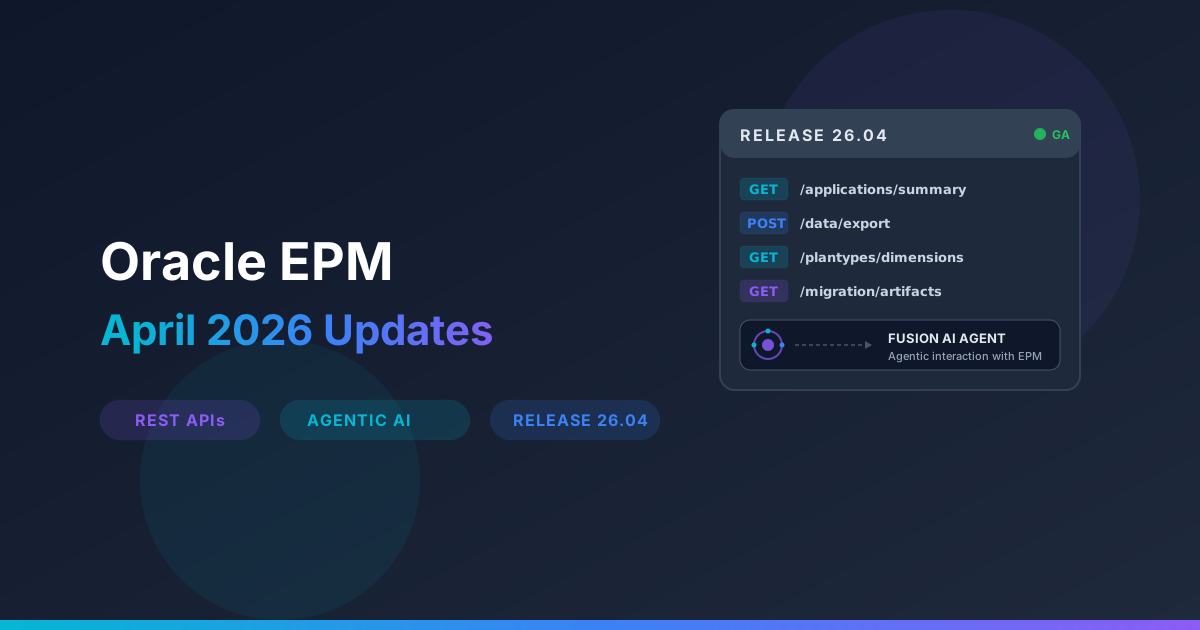
Before we get into the details, I am excited to share that many new REST APIs have been introduced. And I can, without a doubt, tell you that these are intended for AI agent interactions with EPM Applications. And obviously, you could build AI applications that interact with your EPM Applications
OCI / Platform Updates
There are a a few Platform updates that I would like to highlight. And these to me are going to improve user experience as well as data access and data encryption.
Ability to View All Environments Belonging to a Subscription ID
A small change. But so useful!! You wil now be able to view all Oracle Enterprise Performance Management Cloud environments associated with a specific subscription ID from the Oracle Cloud console.
Navigate to My Applications, select Oracle Enterprise Performance Management to display the list of environments. You will be able to view the subscription ID for each environment as well
Break Glass Functionality
Seems like we are getting a new new subscription option for Oracle EPM. Oracle will introduce Oracle Break Glass for Enterprise Performance Management Cloud Service (B112331).
What is included, you ask:
- Oracle Managed Access (OMA): requires customer approval before Oracle operators can access environments
- Bring Your Own Key (BYOK): allows customers to use their own encryption key to protect their data
New REST APIs
I am especially excited about all of the new REST APIs and enhancement / updates to existing REST APIs. Like I mentioned earlier, I can see Oracle introducing REST APIs for AI Agent interactions with Oracle EPM Applications. And that is exciting!!
New REST APIs to Support Agentic AI Interaction
The following new REST APIs are now available to help customers enable agentic AI interaction with EPM Cloud by providing application context and supporting programmatic data extraction through queries and forms.
- Get Application Summary: This API returns a comprehensive, AI focused markdown summary of the specified EPM business process application.
- Export Data: This API returns a JSON data grid containing the query results and is designed for programmatic export of large or complex datasets such as analytics, budgets, and forecasts.
- Export Form Data: This API returns a JSON grid with data for a slice defined by the specified form and is ideal for extracting data using a form (by name or ID), especially when the full member intersection/mapping is not known or when the form is asymmetric.
New REST APIs to Retrieve Plan Types, Dimensions, and Dimension Hierarchies
I was so looking forward to these ones!! The following new REST APIs will be available to help customers retrieve application plan type details, the dimensions associated with each plan type, and the dimension member hierarchy for each dimension.
- Get Plan Types: This API retrieves the application plan type details
- Get Dimensions for a Plan Type: This API retrieves the dimensions associated with a specified plan type within an application
- Get Dimension Details: This API Retrieves the hierarchy of a specified dimension within a plan type
New Migration REST APIs
A number of new migration REST APIs are now available to help customers to automate Cloud EPM lifecycle.
- Get Artifact Categories: This API gets the artifact categories, which group the artifacts based on the modules used by the business process.
- List Artifacts in a Category: This API lists the details of different artifacts available within a specific category.
- Export Categories Artifacts: This API creates an incremental backup of specific artifacts in a category in the environment. Generally, you use incremental backup of artifacts of a category to update another environment with incremental changes.
- List Updated Artifacts: This API lists the application artifacts modified in a specific date range. This API retrieves information similar to that present in the Artifact Updates Report.
- List Snapshot Details: This API gets the list of categories within the snapshots available in the environment and the actions that can be performed with the snapshot.
- Get Snapshot Modification History: This API lists the application artifacts that were modified after the snapshot was originally created. Identifying changed artifacts helps you create new snapshots to back up the changes.
- List Artifacts in a Snapshot: This API gets a list of all artifacts of a specified category within a snapshot.
- List Import Options: This API gets the import options effective in the environment for the groups and group members information available in snapshots. These options specify the conditions for importing group membership data of users and groups into an environment from snapshots.
- Set Import Options: This API sets the import options that specify how the import of group membership is handled during import of groups from a snapshot or file.
- Get Migration Status: This API gets information on the artifact migrations that were performed. This API retrieves information similar to that contained in the Migration Status report.
Narrative Reporting Updates
Here are a couple of updates that caught our eyes.
Oracle Analytics Images in Reports
In Narrative Reporting Enterprise deployments, you can now add Oracle Analytics Cloud (OAC) dashboard canvases to your reports as static, refreshable Analytics Images. These Analytic Images can also be inserted into the Narrative Reporting report package as embedded content. To access these Analytics Images, you must first set up a connection to an Oracle Analytics Cloud instance.
Note: Interactive features of OAC dashboards, such as filters, hover actions, and drill are not supported when using Analytics Images. Additionally, this feature is available only for Narrative Reporting Enterprise deployments.
Ability to View PDF Files Inline in the Narrative Reporting Library
You can now view published PDF files directly within the Narrative Reporting (NR) Library using an inline PDF viewer. To access a PDF file, select the Open action to display the document in the viewer without downloading the file.
Such a neat functionality, much needed and something that should have been there from the beginning!!
Other Updates
Here are a few other updates that are new and exciting.
Predictive Cash Forecasting: Integration with Oracle Cloud ERP
Predictive Cash Forecasting integration with Oracle Cloud ERP is now generally available. Along with the existing Predictive Cash Forecasting features, the integration now offers the following features:
- Offers automated ready-to-use integration with Fusion Cloud ERP sources for Accounts Receivables, Accounts Payables, and Cash Management to seed cash flows.
- Provides pre-seeded Data Integration pipelines for Predictive Cash Forecasting integration with Fusion data sources.
- Allows you to drill through to Cloud ERP aggregate Analytical Views and detailed transactions to understand the actuals and forecast in detail and for deeper analysis.
Fusion AI Agents Integration for Cloud EPM
Fusion AI Agents integration is now available for Cloud EPM, enabling organizations to leverage generative AI to interact with Cloud EPM business processes.
Customers can now download AI agent artifacts directly from their Cloud EPM environment (available as EPM Assistant) and import them into Oracle Fusion AI Agent Studio to create and customize AI agents. These artifacts provide predefined agent components that serve as templates for building AI-driven workflows that interact with Cloud EPM APIs.
Customization of Data Integration Roles
User access to user interface functions in Data Integration can now be customized using role-level security. You should definitely check the article by Trey Daniel, MBA . Trey covers this topic in detail.
At high level, Data Integration now ships with two key roles: "Integration - Create" and "Integration – Run”. These roles provide a fixed set of functions that can be performed by a user. Service administrators can add or remove functions available to a role as needed.
Enhanced Run Pipeline Integration Task
In Task Manager, the Run Pipeline automation task will now support custom variables. This enhancement applies to the Run Pipeline task across the following EPM Cloud services:
- Account Reconciliation (New)
- Enterprise Profitability and Cost Management
- Financial Consolidation and Close
- Planning
- Tax Reporting
Note: 🔥🔥The Run Pipeline automation task is now supported for Account Reconciliation business process.
Conclusion
The April 2026 EPM update is one of the most impactful releases in recent memory — and not just because of the feature count. The thread running through nearly every update is agentic AI: Oracle is clearly building the infrastructure for AI agents to read, query, and interact with your EPM environment programmatically. The new REST APIs for application summaries, form data export, dimension hierarchies, and migration artifacts aren't just developer conveniences — they're the connective tissue that will power the next generation of EPM automation.
For finance and IT teams, this means the window to get ahead of the curve is now.
Whether you're evaluating how Break Glass and BYOK fit your data sovereignty requirements, looking to leverage the new Fusion AI Agent artifacts in EPM Assistant, or simply trying to understand what these REST APIs unlock for your organization — Newarc Consulting is here to help.
We work exclusively in Oracle EPM and Fusion, and we translate releases like this one into practical roadmaps for our clients. Here's how we can help you take action on today's updates:
- EPM AI Readiness Assessment — Understand how the new agentic REST APIs apply to your specific EPM environment and where quick wins exist.
- Hands-On Training — We offer live, instructor-led workshops on Oracle ARCS, Planning, Narrative Reporting, Smart View, and Fusion AI Agents. If your team needs to get up to speed fast, we can design a session around what matters most to you.
- Implementation & Advisory — From implementation to managed services of EPM Applications, we've done this before and can help you do it right.
- Custom POCs & Demos — Curious what Fusion AI Agents could look like inside your EPM environment? We build tailored proof-of-concepts so you can see the value before you commit.
The future of EPM is agentic, automated, and AI-driven. Let's make sure your team is ready for it.